How Reliable Are Drivers’ Statements About Their Engagement in Non-Driving-Related Tasks?
Tibor Petzoldt, Daniel Eisele & Sophie Feinauer
Abstract #
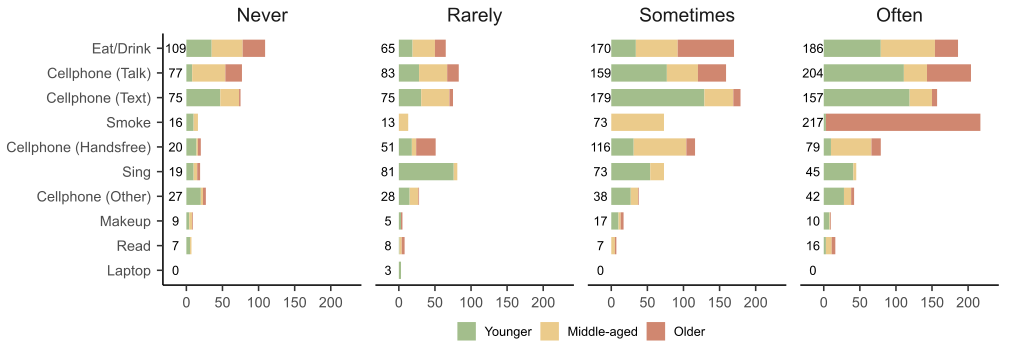
When investigating road user behaviour that has the potential to increase risk (e.g., engagement in non-driving-related tasks; NDRTs), we often must rely on self-reported data. However, for a variety of reasons, the reliability of such self-reports can be called into question. To compare self-reported and actual engagement in NDRTs, we utilised a dataset collected as part of the SHRP 2 large-scale naturalistic driving study, which contains video footage of drivers and their activities while driving. A subset of 144 drivers in three distinct age groups was selected for analysis. In each age group, there were 12 drivers each who reported that over the past 12 months, they had either (a) never, (b) rarely, (c) sometimes, or (d) often engaged in potentially distracting activities such as texting, eating, or smoking. For each driver, 120 short episodes of driving were randomly selected, and any observable NDRT engagement was annotated. The analysis of the data revealed a significant association between self-reported and observed frequency of NDRT engagement. However, it also showed a considerable degree of within-group variance. The predictive value of the self-reports was moderate overall. Differences between the age groups emerged with regard to both the extent and the type of observed NDRT engagement. The results indicate that such self-reports, while reasonably accurate at the group level, should be taken with a grain of salt when used to predict individual behaviour.
Full Text #
Recommended Citation:
Petzoldt, Tibor; Eisele, Daniel; Feinauer, Sophie. How Reliable Are Drivers’ Statements About Their Engagement in Non-Driving-Related Tasks?. In: Mensch, Ann-Christin; Hübner, Carolin; Bornemeier, Julian; Krems, Josef F.; Brandenburg, Stefan (Ed.). Proceedings of the 9th Humanist Conference. 2025.